


Most investors think of Mutual Funds as silent partners - something that quietly works in the background while they go about their daily lives. But the truth is, your Mutual Fund is far from silent. It reflects signals all the time - signals that can offer perspective, provide context, reassure you during uncertainty, and help you understand your investment journey better.
The problem is not that Mutual Funds don’t speak - the problem is that most investors don’t know how to listen. They check their returns, panic during dips, celebrate during rallies, and miss the deeper messages that their investments are trying to convey.
Understanding these signals doesn’t just reduce financial stress - it makes you a more confident investor. When you learn to read what your Mutual Fund is really trying to show you, you stop reacting emotionally and start responding intelligently.
Let’s decode the five most important signals your Mutual Fund sends you - and what they truly mean.
When you open your Mutual Fund statement and see that your returns have moved from +12% to +5% or even dropped into the negatives, it’s easy to assume something is wrong. But fluctuations are not a sign of danger - they are the natural rhythm of financial markets.
Every market in the world goes through cycles. There are months of growth, months of correction, and months where everything seems flat. Equity funds, especially, reflect these market moods almost instantly. A fluctuation doesn’t mean your fund is flawed - it means your fund is connected to a living, moving market.
This signal teaches you an important lesson: volatility is not the enemy. It is simply part of the journey toward long-term investing. Many investors panic when they see temporary negative numbers and make the mistake of stopping SIPs or redeeming their investments. This emotional reaction often leads to regret.
If your goals are five, ten, or fifteen years away, these short-term movements don’t need to disturb you. Your fund is signalling that the journey may have bumps - but long-term progress is shaped by time in the market, not by week-to-week movements.
Many investors think volatility is harmful, but your SIP sees it differently. When the market dips, the NAV of fund units becomes cheaper. During these times, your same monthly SIP amount buys more units.
This is your fund’s way of saying: “Don’t fear the dips — understand them.”
This mechanism is called rupee-cost averaging, and it is one of the defining advantages of SIP investing. If your SIP is buying more units than usual, your Mutual Fund is signalling that the market is going through a phase where accumulation naturally increases. The lower the price, the more units you accumulate - and over long periods, this can influence how your investment progresses as compounding plays out.
Unfortunately, many investors misunderstand this signal. They pause their SIPs during downturns because they think they are avoiding loss. In reality, they are interrupting a process designed to balance out market fluctuations over time.
Your fund is telling you that downturns are not unusual - they are simply part of how long-term portfolios experience different market phases. SIPs are built to convert market movements into disciplined, structured participation.
This signal is a reminder to focus on the long horizon rather than the short-term noise.
There will be times when your fund does not perform as strongly as before. This slowdown can make investors nervous, but it does not always mean your fund is failing. Every Mutual Fund goes through phases of underperformance - sometimes due to changing market cycles, sometimes due to sector rotation, and sometimes because the fund’s investment style temporarily goes out of favour.
However, this signal does deserve your attention. If your fund has been underperforming for a short period, it may simply be a phase. But if it has been lagging behind its benchmark or peers consistently for an extended timeframe, it may be signalling a deeper issue.
This is not a signal to exit without thinking - it is a signal to understand. You might check whether the fund’s strategy has changed, whether the fund manager has shifted direction, or whether the overall market environment is affecting that category.
Sometimes, the fund still aligns well with your long-term goals, and the slowdown is temporary. Other times, the fund may no longer match your requirements or expectations.
Your Mutual Fund is telling you: “Don’t act instantly. Review wisely.”
A thoughtful review helps keep your portfolio healthy — without falling into fear-driven decisions.
If you find yourself feeling anxious during market dips, or if your fund’s volatility feels too aggressive, it may not be the fund that has changed - it may be you.
Risk tolerance is not fixed. It evolves with age, responsibilities, income changes, and even personality shifts. A fund that felt exciting at 25 may feel stressful at 35. A fund that felt suitable before children may feel risky afterward.
When your fund feels “too volatile,” this is a signal worth listening to. It may be telling you that your financial life stage now calls for a different balance or a more comfortable allocation.
This doesn’t mean the current fund is bad. It simply means your circumstances may have changed - and your investment approach may need to reflect that change. Sometimes the fund still fits your long-term goals. Sometimes a different allocation may offer more emotional comfort.
Your fund is signalling: “Check whether your goals, responsibilities, and risk appetite have evolved.”
The right fund is not just the one with good performance - it’s the one you can stay invested in peacefully.
When your fund shows an upward trend over the years — even with temporary dips — it is signalling that your long-term approach is taking shape. Many long-term investors forget to celebrate this signal because slow and steady growth feels “boring.” But this is one of the most meaningful messages a fund can reflect.
Steady progress suggests that your SIP consistency, patience, and long-term thinking are coming together. It shows that the fund has moved through different market cycles and continued to create long-term value in alignment with its strategy and category.
This signal reminds you that your behaviour often matters more than market predictions, news cycles, or expert opinions. Wealth is rarely built in sudden jumps — it is built brick by brick, month by month, year by year.
When your fund grows steadily, it is essentially saying: “Stay focused on the long term. Your future self may appreciate the discipline you show today.”
Conclusion: Your Mutual Fund Is Talking — Are You Listening?
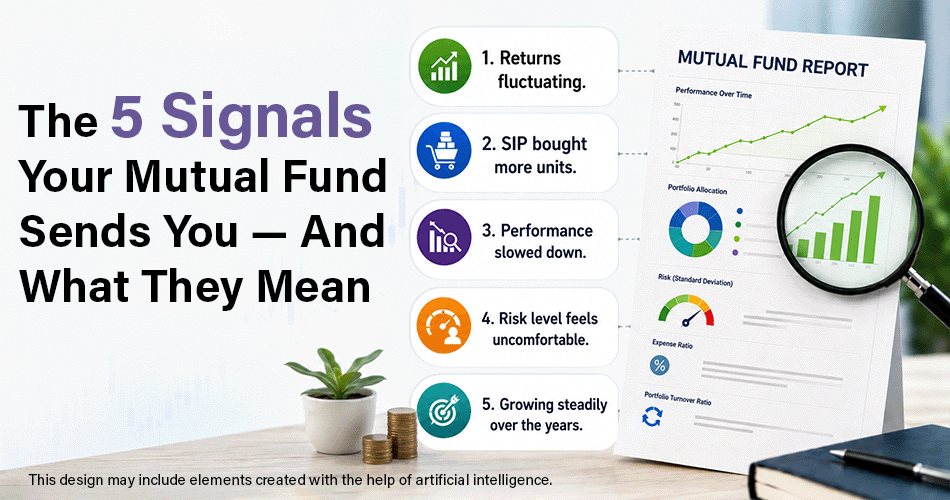
Fluctuations tell you not to panic. Increased unit purchases during dips remind you how SIPs respond to volatility. Slowdowns tell you to review thoughtfully. Discomfort signals a need to reassess your risk profile. Steady progress over time reminds you of the value of discipline.
These signals create clarity. They help you stay focused. They protect you from emotional mistakes.
The market may move unpredictably, but your decisions don’t have to. You can invest calmly, confidently, and consistently — as long as you understand what your fund may be indicating.
Because investing isn’t just about choosing the right fund. It’s about listening to it.
This content is for investor education only. This blog should not be treated as investment advice or a recommendation. Mutual Fund investments are subject to market risks, read all scheme related documents carefully.
C-718, Rajyash rise, narol vasna road,
nr vishala hotel, vasna ahmedabad 380007
+91 8000510580
MK Financial Services © 2022


.png)